by Brian Holmes & Claire Pentecost (στο brianholmes.files.wordpress.com/2009/09/packi... )
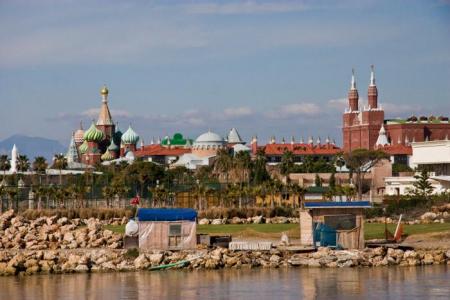
Municipal statue, city of Finicke, Antalya province, Turkey
(all photos CP; published in catalogue of 11th Istanbul Biennial).
An old man with a hearing aid stands with his back to a low wall, juggling a profusion of juicy oranges and bright red tomatoes. One by one he plucks them from the air and sets them down in perfect pyramids, orange and red. The juggler is the neoliberal ideologist Friedrich von Hayek, who thinks that that to act in a world of commodities, all you need to know are their prices:
It is a profoundly erroneous truism, repeated by all copy-books and by eminent people when they make speeches, that we should cultivate the habit of thinking what we are doing. The precise opposite is the case. Civilization advances by extending the number or important operations which we can perform without thinking about them.1
On the other side of the wall is a garden crossed by winding paths. Here and there, gold coins lie scattered on the ground, as if devoid of any value. A bespectacled man in a woolen suit is watering a row of beans in the sun. His name is Karl Polanyi, and he reflects aloud on the history of the industrial revolution:
The middle [or trading] classes were the bearers of the nascent market economy; their business interests ran, on the whole, parallel to the general interest in regard to production and employment… On the other hand, the trading classes had no organ to sense the dangers involved in the exploitation of the physical strength of the worker, the destruction of family life, the devastation of neighborhoods, the denudation of forests, the pollution of rivers, the deterioration of craft standards, the disruption of folkways, and the general degradation of existence including housing and arts, as well as the innumerable forms of private and public life that do not affect profits.2
Both these men were economists, and both became famous in the wake of the Great Depression and the Second World War. Their ideas developed in opposite directions, and over the long run, it is the former with his principle of ignorance who has been vastly more influential. Could the latter have anything to say to us today, in the wake of yet another global crisis? Do artists, curators and intellectuals need to think about what they are doing in the world economy?
The Crystal Casino
After many long walks, drives and conversations in the prodigious city of Istanbul, we set out to discover where the tomatoes and the oranges come from. We thought we might also see how the phantasmatic juggler operates in one of the world’s most prolific gardens. This quest led us down the Mediterranean coast to Antalya, the fastest growing province in Turkey, the center of the country’s tourist industry and the leading producer of hothouse vegetables for export. On these coastal plains we found acres of crystal palaces: the older glass-paned and newer plastic-wrapped greenhouses of the global horticultural industry. Feeding on the same sunny clime were stretches of condominiums for vacationers, shopping malls, and clusters of five-star hotels including replicas of the Kremlin and the Topkapi Palace.

At first glance the scene was uncannily similar to one we had investigated a few years earlier in the Spanish coastal province of Almería. But with significant differences. The Spanish horticultural industry had shallower roots in both time and space. There it had mushroomed in a compressed twenty-year period so that there were none of the older glass and steel palaces erected in Antalya in the 1940s and 50s; rather we saw uninterrupted stretches of flat white reflective plastic roofs stretching into the distant haze. In Spain the vegetables were grown not in local alluvial soil but in packs of imported substrate, regularly cleared and trashed in dumpsites – pesticides, herbicides, plastic and all. The draining of the regional water table to make all this gardening possible in an arid, semi-desert landscape had brought the region much closer to the brink of ecological collapse. And the precarious labor was supplied by migrant Africans, mostly working without papers and suffering the bigotry inflicted on foreign workers worldwide. In Turkey seasonal labor is drawn from the villages of eastern Anatolia, under conditions largely unknown to us, surely not without their own forms of suffering and discrimination.

In both countries we were struck by the singular views of intensive horticulture abutting luxury tourist destinations, locals struggling to make a living through a global export system in unobscured proximity to golf courses, upscale shops, restaurants and marinas designed for the mobile upper classes of globalization. Such a composite offers a perfect example of what we have come to come to think of as an aesthetics of visible blindness: the capacity of select groups to enjoy the fruits of globalized capital while ignoring the price paid in drudgery and insecurity by others. In Spain we had wondered what kinds of dark glasses the tourists must wear, not to see the damaging excess of the real-estate boom, the unsustainability of swimming pools and golf courses springing from the thirsty desert, the conditions of brutal labor exploitation rivaling those of the nineteenth century. Such a blindness is structural: it’s part of what keeps the whole system going even when it’s clearly headed for social and ecological disaster.
Our guidebook on the trip to southern Turkey was written not only by Hayek and Polanyi, but also by the generous Istanbulite sociologist Zafer Yenal, who had given us the name of a grower so that we might see something more than the astonishing view from a rental car. Equipped only with a bad map and a vague idea of our informant’s territory, we lucked into the right village and spoke his name at the local café. Hospitable cell phones immediately went into action and five minutes later we were having coffee with Mikhat, a distinguished tomato producer, and Aydin, the owner of an orange grove and also the muhtar, or village headman. Aydin had taught himself English from a dictionary while working in the greenhouses, and now served us as an excellent translator, with plenty of his own opinions.

The two of them spent their Sunday afternoon giving us a tour of the typical production chain in Antalya. We visited the family owned greenhouses and orchards, the washing and sorting facility, the box folding plant and warehouse. The closest we came to the beginning of the line was a high-tech seedling company. But a full mapping of the production chain is impossible for those who are directly involved. The growers don’t decide what they will plant. In what is called a “buyer-driven market,” the exact patented varieties of tomatoes, cucumbers, peppers and other vegetables grown are dictated by an increasingly consolidated oligopoly of transnational distributors and intermediaries who deliver fresh and processed produce to supermarket shelves. Control of the type of seeds actually in circulation, limited to relatively few out of the vast diversity cultivated through the history of human agriculture, amounts to mastery over the most basic form of shared intellectual property. These gigantic distant players also determine just what other imported inputs – pesticides, herbicides and fertilizers – will be used by small producers throughout the Mediterranean. Such conformity is mandatory if they want to enter the market, and the producers themselves have no bargaining power over the price of these necessities.
Last on our tour was the wholesale depot where teams of kerchiefed women packed produce for shipment and where we sat in the office of the local buyer for a taciturn cup of tea. This buyer marked the end of what could be seen of the production chain from a producer’s vantage point, being the nearest representative of the price mechanism signaled by markets in Istanbul, Russia, Europe and beyond. We were witnessing the scene of our guidebook outlined by Friedrich von Hayek:
The most significant fact about this system is the economy of knowledge with which it operates, or how little the individual participants need to know in order to be able to take the right action. In abbreviated form, by a kind of symbol, only the most essential information is passed on and passed on only to those concerned. It is more than a metaphor to describe the price system as a kind of machinery for registering change, or a system of telecommunications which enables individual producers to watch merely the movement of a few pointers, as an engineer might watch the hands of a few dials, in order to adjust their activities to changes of which they may never know more than is reflected in the price movement.3
Hayek believed that human productivity was most effectively coordinated by the market mechanism, registering changes in the availability or need of products across the earth. Fluctuating prices took the place of knowledge, because the chance to make a profit by selling high or buying low signaled exactly where resources could be allocated most efficiently. There is an eerie correspondence between this theory and the way things really work. What small producers are able to know is indeed reduced since they choose neither the seeds nor the chemical inputs or even the type of bee used to fertilize the plants in the greenhouses. On the selling side of their business they “watch merely the movement of a few pointers to adjust their activities to changes of which they may never know more than is reflected in the price movement.”
In this way they become like players sitting at a roulette table, watching the spinning numbers that will determine how well they fare in a given year. “We are farmers, gambling is what we do for a living.”4 For both inputs and outputs the farmers are deeply integrated into the global food market, and since they have no control over the price of either, their sense of working blindly has intensified as world food prices and petroleum-based input prices oscillate erratically on the readouts of the electronic markets, climbing one year to the heights of prosperity, falling precipitously the next. Whether or not they can make meaningful adjustments to global markets affected by fluctuating demand, oversupply, natural disasters, changing standards, currency exchange rates and commodity market speculation makes the difference between whether they will go bust, hit a jackpot, or just get by. In this way, we discovered, the lives of villagers trying to join a world of consumer abundance are affected by the wild hopes and deep anxieties of what the political economist Susan Strange long ago called “casino capitalism.” With its elegant greenhouses gleaming in the sun alongside the debt-financed palaces of postmodern tourism, Antalya appeared as the land of the crystal casino.
No Accounting For Taste

We spent the night in the town of Finicke, whose main street is adorned with monuments to the magnificent orange. One shows a globe on a pedestal; on top of this concrete world stands a girl holding an orange out to the sky. Producers of all kinds of things want to offer their goods to the world market, and why shouldn’t they? Though the present level of global integration is unprecedented, oranges have been coveted treats in northern climes for centuries. The oranges we brought back from Antalya were some of the best we ever tasted: juicy, sweet and full of complex flavors. We wish we could say the same for the tomatoes, whose flesh was hard and flavorless despite their deep red color and impeccable round design. Are the orange trees holdovers from an older horticulture, unlike the tomato seedlings nurtured in mass-produced plastic trays? Are they less subject to the distortions of just-in-time production? Is it easier to breed an orange for long distance shipping than to breed a packable tomato retaining the tenderness and flavor we recall from our childhoods? Is it a matter of luck? Of preference? Or some kind of obscure gamble with the intellect, the heart, the bank account and the senses?
These questions can be existential ones for those who try to place themselves as tasty products in the world vitrine. While grateful for the chance to travel, exhibit and present in far-flung locales, many of us grow uneasy when self-performance on the art circuit turns into a contest to raise your own price as a signifier of others’ intelligence, passion, perversity or secret foreknowledge of upcoming trends. In financialized economies where speculation on the future values of the sky above can wreak havoc with the ground beneath your feet, it’s quite hard to believe that artistic expression is not just standing in for something bigger to come – like a gigantic hotel, residential complex or entertainment district that will wipe out the gritty neighborhood whose vibrant local life inspired you. We’ve thought about these problems for years, while trying to develop other contexts for the expression, reception, elaboration and understanding of art practices.5 And when food prices spiked with the commodity bubble of 2008, then plunged again after farmers around the world had been lured into costly investments, we found it even harder to keep our desires focused on the next invitation to Asia / Latin America / Western Europe / the Middle East. We too felt like cherry tomatoes on a roulette wheel spinning wildly out of control.
In Antalya province at the site known as Yanartaş arises the famous Mount Chimaera, known since late Antiquity for its flames that flicker in the night, for its literally burning ground. Historical sources cite this geothermal wonder as the origin of the myth of the Chimera, a fire-breathing hybrid of lion, goat and serpent; while the natural explanation describes exhalations of methane from metamorphic rocks. This mythical and real place reminds us of contemporary Chimerica, the hybrid continent we try to call home. For the last ten years its Eastern workers have produced nearly everything its Western consumers crave, while the East side lends back to the West the money received for the floods of goods, in order to keep the wheels of industry turning.6 This unusual geographic phenomenon, characteristic of the global division of labor and power, has been one of the mysteries of late Neoliberalism. What kept mankind alive on its disjunctive territory, from Chicago to Shanghai, was a system of exchange whose human foundations no one cared to know, as long as the volatile prices added up to profits for politicians and businessmen on both sides. The lure of gain stoked a decade of unsustainable development, reflected outside the centers of accumulation by the ugly mirrors of impoverishment and war. Meanwhile, those tastes that market researchers can exhaustively account for – consumer drives and investor appetites – sucked the juice of life from two vast populations, while setting the stage for an economic collapse on a scale last seen in the 1930s. The natural explanation in this case was not metamorphic but mathematical.
About a hundred and fifty years ago, Marx described the commodity as that product of human labor whose exchange value, seemingly animated with a life of its own, acts to render invisible the social relations that produced it. About twenty years ago, some inglorious number-crunching quant invented a meta-commodity called the “collateralized debt obligation” (CDO). It’s a derivative contract whose price is determined by a statistical analysis of the behavior of underlying assets, which in this case are not things but the ability of borrowers to pay their loans. What these meta-commodities did was allow banks to sell to distant investors the revenue expected from payment on home mortgage loans, so that the bank which initially did the lending got its capital back from thin air, and could immediately go out looking for more borrowers on the ground. To make the deal sweeter for the distant investors, the loans were split into tiny fractions and recombined with hundreds of others, so that the risk of any single failure to pay was diluted by the hundredfold. Meanwhile other quants calculated the statistically average rate of bankruptcy on the housing market, which was considered to have the regularity of a natural phenomenon. Another kind of derivative, known as a “credit default swap” (CDS), was sold as insurance on this risk, and indeed on many others, in combinations and hybrids that defy the imagination.
The brilliance of the math and its perfect correspondence with the laws of financial nature omitted just one tiny detail, which was that this circular, self-reinforcing system entirely transformed the markets it was supposed to regulate and stabilize.7 Prices rose from the ground like tongues of fire until they reached trembling heights: cut off from all connection with the underlying capacity of the borrowers to pay, the flame fell back to earth and burned everyone it touched. As foreseen, the default insurance went into effect, but for losses exponentially exceeding what had been judged possible in nature. And then, metamorphosing from the joyful illusion that it once seemed to be, the fabulous Chimerican prosperity of the early 2000s turned into a monstrous creature, rampant in every country on the face of the earth.
We do not know exactly where the current crisis will lead. But what we have been foreseeing for the last several years is “Continental Drift”: a rearrangement of the unlikely bicontinent in which we briefly lived, the decline of the US dollar as the world’s reserve currency and the beginning of far-reaching changes in the geopolitical order.8 Rather than speculating right now on what those changes may bring at the global level, it may be more useful to draw some conclusions about the relations of art and economics in the period we have just lived through.
From the current economic perspective, growth is the only measurable good, making the signs of rising profit into the one convincing form of beauty. Wall-to-wall computers, flashing LEDs, gleaming glass and glittering buildings are among the finest sights, but the highlight in the flesh is always the person on the stage, the speculative performance. You too can be a top-value signifier, seemingly animated with a life of your own. And a world-class museum can become the gateway of real-estate paradise, if the bar is more spectacular than the paintings. Since your price is moving upwards on the market, why not let gentrification be your derivative? Very few people involved in contemporary art actually think this way, but very many of the funding decisions in the cultural world are made on exactly this basis.
Where the commodity as described by Marx acted to conceal the social relations of labor that produced it, the meta-commodities of our time act to conceal the collective deliberations that create the environment in which any labor, leisure, productivity or culture can take place. The government of human affairs has been privatized by the calculations of a supposedly natural law. The veil over all this is what we’ve been calling the aesthetics of blindness. But if that is the case, those of us working art face one very important question. How could the veil be lifted?
Touching Ground
Let’s look through the spectacles of the man watering the beans in the garden, with gleaming coins scattered here and there as though devoid of any value. Polanyi’s major work, The Great Transformation (1944), retraces the rise and fall of the gold standard, which served as the global medium of exchange during the period of the British Empire. More profoundly it studies the belief in a self-regulating market, elevated to the status of a natural law whereby supply and demand automatically find their proper equilibrium. The self-regulating market is the underlying structure designated by Adam Smith’s metaphor of the invisible hand, then later by Hayek’s more pragmatic image of the telecommunications system. Looking further, Polanyi observed that the fundaments of human existence – labor, or the health of our bodies; land, or the cyclically recurring growth of the natural world; and the human institutions of governance, including money itself – were treated as freely available resources by the capitalist market which invested no care in their reproduction over time. Labor, land and money are “fictitious commodities” by Polanyi’s account, because their actual origins and destinies lie outside the market, even though the market depends on and depletes them. The Great Depression and the World Wars are historical examples of the price ultimately paid for their neglect.
The persistent recourse in economics to the illusion of a natural market law serves to justify the core functions of labor and resource exploitation, while the investment of financial signifiers with supernatural powers acts to distract from the many crimes that accompany the system (or some would say, provide its very basis). These include imperialism, or the plunder of distant territories by force of arms; enslavement, or the physical coercion of human beings against their will; the formation of monopolies and oligopolies, permitting the fixing of prices in markets closed to the entry of smaller producers; and more recently the reign of mass deception, whereby will and desire themselves are reshaped by the media bombardment of manipulative messages. The grip of the natural law delusion is what gave Margaret Thatcher her hour of credibility, adamantly repeating “there is no alternative.” It’s remarkable that since the present round of computerized and networked financial innovation began in the mid-1970s, the ranks of the number-crunching quants and the formulas they employ are drawn largely from theoretical physics, reinforcing the economists’ claim to be describing unequivocal phenomena of nature.
What makes Polanyi so interesting is his refusal of this natural market law. Yet unlike communist planners of the early twentieth century (to whom neoliberals automatically reduce any proponents of an “alternative”) he did not believe that human needs and possibilities could be calculated by a central agency. He understood the dynamics of human societies to be the result of three quite different fields of organization, each of which does not function according to any inherent natural law, but instead by the more-or-less conscious development of ad hoc principles that gradually work themselves into a sustainable balance. The first of these broad fields of human interaction is exchange, which occurs in a bewildering variety of forms across history, and not only as the reductio ad absurdum of human relations to monetary mathematics. The second, still quite apparent to the citizens of modernized societies, is redistribution as it is carried out by a centralizing administration. In recent history this was the welfare-state function, largely banished by the class politics of neoliberalism. The third domain of social coordination, almost as ignored by official scholarship as it is by market fundamentalists, yet one which still pervades and supports contemporary life, is reciprocity: the informal circulation of services, privileges, favors, care and support between individuals, families, clans, friends, voluntary associations and identity groups. It was a notion of open-ended reciprocity that prompted a Turkish sociologist to share his rural contacts with us, that made those contacts treat us as guests to whom they offered time, information, openness and a splendid local lunch. In many more incalculably extensive ways, it is reciprocity that undergirds and makes livable the harsh inhabitation of a world ruled by market numbers.

By recognizing these three fields in their heterogeneity and in the specificity of their mutual interaction it is possible to go beyond the eternal quarrels of the liberals, the communists and the anarchists, each of whom insists on the preeminence of just one field: the market, the state or voluntary association. Unfortunately, they cannot even adequately describe the real workings of their single sphere of interest, since society is always constituted by particular combinations of all three. Rather than operating within or against an idealized totality that does not exist on its own, one finds more chances in navigating between existing realms whose specific relations can be played against each other, and changed for the better.
This multidimensional understanding of society provides the tools to draw up much more useful maps of complex situations, including multiple roles for art. When the market is invested with a superhuman accuracy of judgment, critics and institutions too often validate only what it has already validated. In this scenario the artists become like our counterparts the horticultural producers, conforming their inventions to signals from a distant empire of finance. But neither would it be satisfactory to have the state manage what kind of art will be produced and experienced. Nor is it enough to have an art with no relationship to exchange or redistribution. Art is a shifter between the three broad fields of interaction, dramatizing insufficiencies, suggesting possibilities, escaping deadlocks, opening utopias and bringing overly theoretical principles back home to lived experience. As cultural producers we want to bring this full range of possibilities into play – in order to touch the ground, to regain some contact with the fundamental conditions of existence.
Sixty-five years ago, in a phrase whose timeliness verges on the uncanny, Polanyi wrote that “the trading classes had no organ to sense the dangers involved in the exploitation of the physical strength of the worker, the destruction of family life, the devastation of neighborhoods, the denudation of forests, the pollution of rivers, the deterioration of craft standards, the disruption of folkways, and the general degradation of existence including housing and arts.” The sentence strikes home in a world marked by climate change, financial crisis and war. If exactly the same problems are facing us today, then isn’t this what art most urgently needs to become: a sense organ of humanity, a space in which to perceive and express the transformations that human groups are unleashing upon themselves and their environments? A space in which to inquire about the creation of value, the roots of conflict, the sources of vital energy, the paths toward better ways of living?
Of course, much of artistic production already does that, but in contexts made confused and ambiguous by the operations of financialized taste. What is finally becoming more obvious today, in the context of the triple crisis – economic, ecological and geopolitical – is that mainstream cosmopolitan culture has been largely absorbed into a predatory system of capture and manipulation, instilling commercial ideologies and prosumer drives and generating multiple forms of self-interested blindness even in the spaces devoted expressly to vision. The resulting breakdown of the human ecology, or lack of sense in world affairs, is provoking a widening crisis of legitimacy. This explains the election of a relatively idealistic figure like Barack Obama, or at a smaller scale, the selection of a group like WHW to curate the Istanbul Biennial. The question is what to do with the opportunities offered by this legitimation crisis.
Some practitioners have recognized that if art is to play any autonomous role in the shaping of contemporary sensibilities, it should be developed and evaluated within spaces of reciprocity where the predatory functions have no hold, whether these are private spaces, self-organized associations, informal networks of exchange or independent media projects. We are not just talking about strong images emerging from circles of peers under particularly turbulent social circumstances, which can now capture lots of attention on the markets. If art is to escape overcoding by existing value-forms, it must be created along with philosophical concepts and forms of social practice that are resilient enough to preserve their integrity despite the existing norms and functions. State institutions – not to mention corporate sponsorship – cannot be trusted to provide the context of art production, for one simple reason: the current panorama shows the extent to which they have failed. Yet at the same time, many positive developments on the cultural landscape show that artists, critics and curators who have developed strong networks of reciprocity can also find allies in both state-redistributive and market-exchange institutions, in order to develop singular and transformative proposals and to distribute them widely.
In our view – and this could be our polemic – the forces of reciprocity are not politically alive enough in art today. If we have worked with activism, and if we have developed autonomous critical initiatives like Continental Drift, it’s clearly for this reason, to engage in productive dialogues with other initiatives that have opened breathing spaces instead of just adapting to their instrumentalization. Today under the pressure of a triple crisis that will no longer go away, but only continue to morph into successive forms, it is necessary for artists, intellectuals and curators to develop higher levels of ethical exchange before engaging with the compromises of the state and market spheres. Not to maintain a politically correct consensus or some vain illusion of purity and self-sufficiency, but to find the precise resources that are needed to open up intense and problematic spaces of perception, revealing in advance the further conflicts and collapses which await and threaten – while in the best of cases offering broader perspectives, sweeter affects, clearer concepts and more generous actions in reality.
Polemics aside, we’ll close with an attempt to answer this essay’s recurrent questions. They have to with the origins of taste, the creation of alternatives, and the place of perception in artistic expression. Since one of the problems we’ve identified is an excess of economically animated forms and performances – a visible blindness – our research will shift further toward a tactile dimension.
Worlds At Your Fingertips
In a memorable passage from an unfinished book, a philosopher performs the simplest experiment in perception: touching one hand with the other. Maurice Merleau-Ponty worked in the tradition of phenomenology, trying to provide a philosophical definition of the primary scientific act: the clear and distinct perception of an object by a subject who stands outside it, exterior to what is being perceived. But when your fingers touch your own fingers, perception doubles back on itself and the subject becomes inseparable from the object. In this common experience the scientific mind must confront its own presence, its pulsating inherence to the phenomena that it wants to put at a distance. Like the casting of a gaze, touching involves the expression of a desire to know the world that is indissociable from whatever we will ultimately know of it. Yet there is a still more common and more poignant experiment in perception: one hand touching someone else’s, my hand touching yours. It is through this common experience that one discovers other worlds.
The self-reflexive turn of phenomenology shows that expression – and along with it, the vast material of spoken and written language – is an irreducible part of perception.9 Consequently, the upsurge of the new and the encounter with the other can only be sensed in historically shared frameworks of words, ideas, artworks, urban forms etc, themselves existing flush with perception and in intimate contact with its proliferating differences. To perceive is to constitute the object with the quality of your own attention, but also to be constituted by it: perception is a self-affecting movement that changes the very nature of one’s sensorium, while spilling over through language, gesture and affect to others who also perceive, reflect and evaluate. In this way sense is made. Overflowing from each body in the world, the reciprocal relation of perception and expression gives rise to cultural experience: crisscrossing artifacts of sensate desire, overlaid upon each other in complex patterns that point beyond whatever they designate, toward the depths and the horizons of the worlds we constitute together.
Merleau-Ponty called this intertwining of perceptions “the chiasm” – a Greek word designating a point of crossover between two flows. An example would be the optic chiasm, where the nerves coming from the left and right eye cross and intermingle before vision separates again into different areas on the right and left sides of the brain. We have yet to find Lake Chiasma on the natural landscape, but we know this feeling of plunging into and emerging from intertwining perceptual worlds.
The emphasis on perception could evoke practices of a documentary nature: attempts to film, photograph, sketch, graph, record, speak or otherwise represent the world. Such practices are extremely important, because they offer a chance to begin overcoming the blindness of contemporary society. Yet we must take one further step toward a politics of perception. In a critique of phenomenology and specifically of Merleau-Ponty, another philosopher shows that what is never taken into account by the scientific gaze is the human imagination. What happens, asks Cornelius Castoriadis, when we focus our attention on dreams, on delirium, on hallucinations? When last night’s dream is taken as a valid object of perception, “all of philosophy is knocked out of order.”10 Yet dreams and visions, like images themselves, are also common phenomena. They are the bearers of their own particular kind of truth and capacity to change the world.
There is a name for the insurgence of the image as a productive force in human thinking: the radical imagination. Castoriadis defines it as “the capacity to posit that which is not, to see in something that which is not there.”11 This imagination is not only visual: it is auditory, tactile, gustatory, olfactory, it is sexual and affective, it touches other people. Here is the intersubjective force that transforms our relation to nature. Those who proclaim the inexorability of market law do not only refuse to perceive its obvious failings; they also try to cover up the human potential to see what is not there, to express an aspiration. The politics of perception is inseparable from a collective exercise of the radical imagination. As Castoriadis explains: “I call autonomous a society that not only knows explicitly that it has created its own laws but has instituted itself so as to free its radical imaginary and enable itself to alter its institutions through collective, self-reflective, and deliberate activity. And I call politics the lucid activity whose object is the institution of an autonomous society.”12
Polanyi wrote the history of the self-regulating market up to its first culmination in the mid-twentieth century, showing that its claim to a basis in natural law was fictive, and that under the cover of this fiction it destroyed the traditional institutions on which it was based in reality. He called for the creation of new institutions, which could successfully re-insert or “re-embed” the world market into a tissue of acknowledged interdependencies that would stabilize it and keep it from exerting its most destructive effects. Today we are light years from that kind of wisdom. Yet it is still possible to conceive another society, not by the appeal to natural law but by the exercise of the radical imagination, and by its transformation through a political process into collective institutions.
Museums in the overdeveloped countries are still primarily used for historical conservation and the validation of isolated personal expression, though they are increasingly becoming sites of social design as well, launching pads for new product-behaviors.13 But what contemporary societies more urgently need are experimental institutions where the perception of lived environments, the creation of tastes and values and their codification into laws and definitions of reality can all be played out again in concentrated symbolic forms, which include contestation, ambiguity and internal contradiction. It is the artists’ intervention on powerfully articulated symbolic material that can touch others, elicit responses and open up a space of reciprocity for many different uses of the radical imagination.

An international exhibition or biennial can be this stage or arena, a time made of many temporalities, a place where many places and their inhabitants come to meet. This does not mean that everyone will agree. In an age marked by extreme exploitation, environmental destruction and violent conflict, it’s likely that they won’t. But the exhibition can also be a place to sharpen new symbolic weapons, or to shift the terms of old arguments. Instead of instilling preprogrammed behaviors in a manipulative way, it allows for self-conscious experimentation with the orientations of one’s own perception, and for debate about the possible worlds that are bodied forth in images.
We were touched by our visit to Istanbul, and by our glimpse of a life out in the countryside that we could never have imagined – despite its arrival in bits and pieces to faraway supermarkets. As in the naïve image of the girl standing on a globe and holding the fruit of her local culture up to the sky, we wanted to offer some food for thought in return: a glimpse of the kinds of knowledge that artistic practices can bring, a feel for singular situations whose life on the ground can never be communicated by the abstract movements of a pointer on the dial of the global markets. To engage with this knowledge, rather than ignoring it, is one way to contribute to a systemic change. Maybe it’s another kind of gamble, but this is what we are looking for in art today: a politics of perception.
Notes
1Friedrich von Hayek, “ The Use of Knowledge in Society,” in The American Economic Review 35/4 (September 1945), p. 528. Hayek borrows this quote from the philosopher Alfred North Whitehead, but uses it for purposes very much his own.
2Karl Polanyi, The Great Transformation (Boston: Beacon Press, 1957/1st ed. 1944), p. 133.
3Hayek, “The Use of Knowledge in Society,” op. cit. pp. 526-27.
4Calgar Keydar and Zafer Yenal, “Facing Globalization: Transformation and Adaptation in Turkish Agriculture” (unpublished manuscript).
5Cf. Brian Holmes, “Emancipation,” in Unleashing the Collective Phantoms (New York: Autonomedia, 2007), available at http://www.mail-archive.com/nettime-l@bbs.thing.net/msg02007.html; Claire Pentecost, “Autonomy, Participation And,” in Rick Gribenas, ed., Participatory Autonomy (New York: Autonomedia, 2008), available at http://www.clairepentecost.org/autpart.html. Also see the Ten Point program of the Mess Hall autonomous space, which Claire Pentecost had a hand in drafting: see http://www.messhall.org/ten_points.html.
6The concept of an economic hybrid between China and the USA was introduced in 2007 by Niall Ferguson who, betraying an extreme lack of foresight, considered this newly founded continent to be sustainable. See “‘Chimerica’ and the Global Asset Market Boom,” International Finance 10/3 (December 2007).
7This is the thesis of the brilliant study by Edward LiPuma and Benjamin Lee, Financial Derivatives and the Globalization of Risk (Durham: Duke University Press, 2004).
8See the seminar archive at http://www.16beavergroup.org/drift, as well as Brian Holmes, “One World One Dream: China at the Risk of New Subjectivities,” in Escape the Overcode: Activist Art in the Control Society (Zagreb: WHW/Vanabbemuseum, forthcoming), available at http://brianholmes.wordpress.com/2008/01/08/one-world-one-dream.
9See Maurice Merleau-Ponty, The Visible and the Invisible (Evanston: Northwestern University Press, 1968/1st French edition 1964), esp. chap. 4, “The Intertwining – The Chiasm.”
10Cornelius Castoriadis, “Merleau-Ponty and the Weight of the Ontological Tradition,” in David Ames Curtis, ed., World in Fragments: Writings on Politics, Society, Psychoanalysis, and the Imagination (Palo Alto: Stanford University Press, 1997), p. 277.
11Cornelius Castoriadis, “The State of the Subject Today,” in World in Fragments, op. cit., p. 151.
12Cornelius Castoriadis, “Psychoanalysis and Politics,” in World in Fragments, op. cit., p. 132.